Search Results for: root cause

7 Steps to writing an FDA 483 response

Responding in 15 business days is one of 7 steps on how to write an FDA 483 response, but do you know what should be in your response?7 steps fda 483 blog 7 Steps to writing an FDA 483 responseWhen an FDA investigator has an inspection observation, the investigator issues an FDA 483. “Form 483” is the FDA form number. If your company receives an FDA 483, it is critical to understand how to write your FDA 483 response in order to avoid a Warning Letter. In the words of a former FDA investigator, “Many, many times I have seen an [Official Action Indicated (OAI)] classified inspection that had been recommended for a Warning Letter by the compliance branch be set aside based upon the response of the firm.”

Square subscribe to our blog button 281x300 7 Steps to writing an FDA 483 response

The best way for your company to write a FDA 483 response is to provide a brief cover letter and to use your CAPA process. Every 483 inspection observation needs to be addressed in the FDA 483 response as a separate CAPA. Make sure that your response includes the following seven steps below:

  1. respond within 15 business days (earlier is better)
  2. use your CAPA form and a cover letter–instead of a memo
  3. document the investigation that was conducted with a concisely stated root cause
  4. identify containment measures and corrections to address each specific observation by the FDA inspector
  5. identify corrective actions planned and the date(s) you expect to complete implementation
  6. Include documentation of containment, corrections and corrective actions that are completed at the time you submit the response
  7. follow-up with a memo confirming that all the corrective actions are complete and include all related documentation–including training for any new procedures or any new corrective actions that warranted training

Your FDA 483 response is required in less than 15 business days

The FDA has always involuntarily required a medical device firm, or any firm under FDA jurisdiction that received an FDA 483, to provide a written FDA 483 response to the District Office within 15 business days. As of two years ago (http://www.gpo.gov/fdsys/pkg/FR-2009-08-11/pdf/E9-19107.pdf), it became mandatory that the Agency must receive a FDA 483 response within 15 business days, or an automatic Warning Letter is issued. You need to respond aggressively to FDA 483s with corrective actions, and submit your response early. The FDA has also modified the format of the response to require email responses.

Use your CAPA forms instead of a memo.

I have asked several former FDA investigators whether they would prefer to see firms submit responses in memo format, or by using their CAPA forms and a cover letter. Some told me that they prefer to see firms use their CAPA forms, while others don’t seem to have a preference. Nobody from the FDA has ever indicated a preference for a memo. I see no point in doubling your work and risking transcription errors. If you have an electronic system that does not have an easy-to-follow output format, go ahead and copy-and-paste the information from your electronic database to your memo. If the CAPA system output is easy to follow, just use a cover letter and copies of the forms.

Document the investigation and root cause

This is definitely my pet-peeve, but a one-sentence “root cause” is not enough for an FDA 483 response. Regardless of whether I am doing a mock-FDA inspection, an internal audit, or a supplier audit–I expect you to document how you determined the root cause (http://robertpackard.wpengine.com/five-tools-for-conducting-root-cause-analysis/). If it’s trivial and obvious, then it must have been something important, or I would not have written a nonconformity. Therefore, you should be looking beyond the immediate scope of the FDA 483 to ensure that a similar problem cannot occur elsewhere. In the language of the FDA, this is a preventive action, because you are preventing occurrence with another process or product. Most ISO certification auditors are purists, and they won’t accept this as a preventive action. You will have to show the purists something special–maybe from your data analysis.

Don’t forget containment and correction

For every 483 observation, including the subparts, you need to identify if immediate containment is necessary and how you can correct the problem. Whenever possible, you should attempt to implement the containment and corrections during your FDA inspection. It would be fantastic to give the FDA inspector a copy of the new CAPA you initiated during the audit. The new CAPA would identify containment and corrections that have been or will be implemented–including any nonconformity(s) you initiated to quarantine product. You may still get an FDA 483 inspection observation, but you are likely to convert a possible Official Action Indicated (OAI) into a Voluntary Action Indicated (VAI). You can also modify the CAPA wording later in your FDA 483 response to include a cross-reference to the FDA 483 and quote the exact wording the inspector uses.

Explain the corrective action plans and timelines

Clarity, brevity, and realistic plans are critical in this section of your response. I prefer a table that looks like the example shown below.

7 steps 483 chart 7 Steps to writing an FDA 483 response

Show the FDA you have already taken action in your FDA 483 response

Whenever possible, you want to show the FDA that you are taking action without delay. If you revised the SOP for MDRs and scheduled a group training for July 15, then you should provide the FDA a copy of the revised procedure and a copy of the agenda for your planned training session. The only caution is to only commit to actions you are certain you will implement. You can always do more, but it will be much harder to explain why you did not implement an action you submitted in your FDA 483 response.

Follow-up with a second FDA 483 response before the FDA asks for it

The FDA’s compliance office will be looking for a response when an FDA 483 is issued, and they will review your response. The investigator will get a copy of the FDA 483 response, and the investigator will comment on the response. The compliance office and the investigator enter their comments into a CDRH database. Still, the comments are only general, as to whether the response is adequate or inadequate and will require additional review.

If you do not hear back from the FDA, do not assume that the compliance office or the investigator was satisfied. You should also follow-up several months later (earlier if possible) with a letter that includes evidence of the completed corrective actions, and your verification of effectiveness. If the verification is compelling and received in less than six months of the inspection, you may convince the compliance office to hold off a planned Warning Letter.

If you are interested in root cause analysis and improving your CAPA process, we have two related webinars:

7 Steps to writing an FDA 483 response Read More »

Stage 2 Audit – How to Prepare (Part 1 of 2)

This blog teaches you how to prepare for a stage 2 audit on your pathway to ISO 13485 certification, and this blog is part 1 of 2.last prep Stage 2 Audit   How to Prepare (Part 1 of 2)

Stage 2 Audit

If you are not sure what ISO 13485 is, please consider our 2-part training webinar on the topic. Health Canada requires ISO 13485 certification as a requirement for all Medical Device License Applications, and most companies choose ISO 13485 certification as their method for demonstrating conformity to the requirements of the European Medical Device Regulations (MDR)–instead of a special MDD audit.

Square subscribe to our blog button 281x300 Stage 2 Audit   How to Prepare (Part 1 of 2)

To achieve ISO 13485 certification, you must successfully complete a Stage 1 and Stage 2 certification audit with your chosen certification body. If you are interested in an overview of this certification process, you can download Medical Device Academy’s white paper on this topic, or you can watch a webinar we recorded recently on 6 steps to ISO 13485 Certification.

Management Processes are covered during the Stage 1 and Stage 2 audit

The Stage 1 audit is typically a one-day audit where the auditor is evaluating your readiness for the Stage 2 audit. The auditor will review your Quality Manual, and your procedures (19 are required) to ensure compliance with ISO 13485. Also, the auditor will sample records from critical processes to assess your readiness for the Stage 2 audit. Typically, these processes will be:

  1. Management Review
  2. CAPA
  3. Internal Auditing

After you complete the Stage 1 audit, you may have a few nonconformities identified by the auditor. Responding to these nonconformities is the first step in preparing for your Stage 2 certification audit. You need to initiate a CAPA for each of the auditor’s findings and begin implementation before the Stage 2 audit. Typically, you will have about six weeks to implement these actions. This is not usually enough time to complete your CAPAs because you need more time before you can verify the effectiveness of corrective actions.

Preparing CAPA Records is critical for your Stage 2 audit

In preparation for your Stage 2 audit, prepare for the auditor to review any CAPAs that you completed since the Stage 1 audit–especially if you have evidence of completing an effectiveness check. You may think this is unnecessary because the auditor previously reviewed CAPAs during Stage 1. However, you probably received a nonconformity related to your CAPA process (almost everyone does), and you should expect auditors to review your CAPA process during every audit.

CAPA Effectiveness Graph 300x218 Stage 2 Audit   How to Prepare (Part 1 of 2)Each CAPA record you present should be provided in a separate folder as a paper, hardcopy. The paper, hardcopy makes it easier for the auditor to review. The folder should include documentation of the investigation, a concise statement of the root cause, and copies of records for all corrections and corrective actions implemented. Corrective actions include procedure revisions and training records. If there is a quantitative measurement of effectiveness, include a graph of current progress with the record. Ideally, the graph will be one of your quality objectives. The graph to the right is an example.

Production Process Controls will get the auditor out of the conference room 

Every company has at least some production and process controls implemented before the Stage 2 certification audit. Most auditors and inspectors spend too much time in conference rooms reviewing paperwork and too little time interviewing people that are performing work. However, many companies also outsource production activities. Therefore, unless you have a software product, you can expect your auditor to review incoming inspection activities. The auditor is also likely to review the finished device inspection, storage, and distribution. If the auditor is thorough, they will also follow the trail from inspection activities to calibration activities, nonconforming materials, and data analysis.

Design Controls

If your company is a contract manufacturer, then you probably are excluding design controls (ISO 13485, Section 7.3) from the scope of your Quality System. However, if you are a manufacturer that performs design and development, then it is an element of the quality system that warrants special attention. During the Stage 1 certification audit, the auditor reviewed only your Design Control procedure. During Stage 2, the auditor will look for evidence of implementing design controls. Therefore, even if your company has not completed your first design project, the auditor will still want to see some evidence of implementation. The auditor will expect at least one design plan to be written, and at least one design review should be completed.

If you are familiar with the FDA Quality System Inspection Technique (QSIT) process for inspection, you might have noticed that this blog is divided into the same subsections identified in the QSIT Manual.

Stage 2 Audit – How to Prepare (Part 1 of 2) Read More »

7 Considerations for Outsourcing Medical Device Complaints

complaint handling 7 Considerations for Outsourcing Medical Device Complaints

Investigating medical device complaints can be a time-consuming task. This blog reviews seven considerations for outsourcing medical device complaints.

Square subscribe to our blog button 281x300 7 Considerations for Outsourcing Medical Device Complaints

Two different clients of mine recently mentioned that they are overwhelmed by the amount of time required to investigate complaints and to file MDRs with the FDA. I suggested outsourcing the complaint handling to a third-party service provider, but they were unaware of any suppliers with that capability.

I was already familiar with several suppliers offering these services, but I wanted to know if companies were looking for these services. Therefore, I decided to post a discussion on one of the LinkedIn groups I manage: http://bit.ly/LinkedIn-ComplaintThread. In just two days, there were 21 different comments. Most of these were from consultants offering their services, but their comments were helpful. For example:

  1. “The majority of complaint handling work typically involves a high volume of less critical tasks. Routine things like ensuring all potential complaints are entered into your system, requesting additional information when its needed, documenting updates when they are received, or drafting complaint/reportability decisions based on company policy are all tasks that can easily be performed by a well-qualified service provider for significantly less than if they were done domestically.”  – Matts Bell
  2. “Direct input into ESG is much better and easier than an additional third party software package, as ESG does change often, and the software companies are not keeping up. Keep in mind that each change digs deeper into the quality system and information. What is acceptable today may not be acceptable tomorrow as the validation keys within ESG tighten.” – Courtland Imel
  3. “I too, have provided outsourced complaint, NCMR and CAPA investigations, customer contacts, and root cause analysis to final disposition, sometimes in an FDA remediation project. But it requires active involvement on the part of the client company, with periodic meetings to discuss each case/its resolution, as well as identified trends/their resolution.” – John E. Lincoln
  4. “In the case of adverse events identified through the litigation process, the company cannot contact the complainant directly because the case is in litigation…Utilizing an appropriate third-party service provider to work with you on this process can make this type of adverse event reporting fast, efficient, and cost-effective.” – Melissa Becker

It is true that parts of complaint investigations must be performed internally—such as failure analysis. You also cannot outsource responsibility for review and approval of complaint records or MDRs. However, suppliers can provide trained personnel that are capable of initiating and completing complaint records, performing follow-up with complainants, and determining if complaints are reportable to the FDA and other countries around the world. One of the suppliers I interviewed can translate adverse event reports for countries that require reporting of adverse events in languages other than English, and they have a professional translator verify accuracy. Some personnel even have a medical background (e.g., nursing).

7 Considerations for Outsourcing Medical Device Complaints 

  1. Find a supplier that has many years of experience helping medical device manufacturers with complaint handling and adverse event reporting (no rookies)
  2. Ask for a demo of the software—web-based software is best (I’ll explain why shortly)
  3. Ask to see their complaint handling procedure and perform a procedure review
  4. Ask how the supplier handles complaint investigations when the product is not returned (http://bit.ly/DeviceNotReturned)
  5. Verify that the rationale for MDR decisions is based upon the FDA requirements in 21 CFR 803 (http://bit.ly/Part803), and vigilance decisions are based upon MEDDEV 2.12/1 (http://bit.ly/MEDDEV2-12-1rev8)
  6. Ensure that the software system has a tracking of timelines for complaint handling and reporting already built-in
  7. Ensure the electronic forms are adequately designed for capturing information—not just yes/no checkboxes everywhere

Why is web-based software better than hosted?

The US FDA is moving quickly toward Electronic Submission Gateways (ESGs) as the preferred method of submissions (http://bit.ly/Why-FDA-ESG). Unfortunately, there are frequent changes to ESGs that require software modifications and revalidation (http://bit.ly/ESG-FDA). Therefore, unless you prefer to have a full-time person responsible for revalidation of software, web-based software solutions are typically your best choice for regulatory submission software tools. It’s also convenient to be able to access records and print them out for an FDA inspector from any computer. This eliminates any possibility of a 483 being issued against 21 CFR 820.198(f) (http://bit.ly/820-198).

7 Considerations for Outsourcing Medical Device Complaints Read More »

Effective Management Solutions for 10 CAPA Program Blunders

The author provides effective management solutions for ten real-life CAPA program blunders., (i.e., procedures, root cause analysis, closing CAPAs, etc.)

%name Effective Management Solutions for 10 CAPA Program Blunders
Effective Management Solutions for 10 CAPA Program Blunders

I am always looking for new and creative ways to help people understand the importance of maintaining an effective Corrective and Preventive Action (CAPA) program. If my last dozen CAPA blogs were not convincing enough, maybe this list of suggestions will help.

Square subscribe to our blog button 281x300 Effective Management Solutions for 10 CAPA Program Blunders

  • 1. If someone doesn’t follow procedures, just fire them. The employee in question is obviously the root cause. Management cannot be held responsible for the actions of employees. Once, I read a corrective action plan that indicated termination was the correction for a missing training record. The QA Manager clarified this statement by saying that the employee resigned for personal reasons, and there was no opportunity to train the employee. The CAPA record also indicated that 100% of the training records for manufacturing employees were reviewed for completion. There were a few records identified as incomplete, and those employees were trained—not terminated. The company also implemented a tracking tool to monitor training records. As a general rule, termination is not an acceptable corrective action or correction.
  • 2. If CAPAs are open longer than your procedure allows, close the existing CAPAs the day before the CAPAs become overdue, and open new CAPAs. CAPAs are not “closed” until all nonconformities have been corrected, corrective and preventive actions are implemented, and effectiveness checks are done. If the corrective and preventive actions were not completely effective, some companies chose to reopen the record and expand the plan of corrective and/or preventive actions. Other companies chose to open a new CAPA record, and reference the new record in the effectiveness check section of the previous CAPA record. Either approach works, but you cannot close an incomplete record and remain compliant.
  • 3. To verify the effectiveness of corrective actions, just include a copy of your document change order. Documenting changes to procedures meets part of the CAPA requirements, but this verifies implementation—not effectiveness. To verify the efficacy, you need to confirm that a nonconformity, or a potential nonconformity, will not recur. Low-frequency defects are often hard to demonstrate directly. The best approach is to validate the process parameters to demonstrate quantitatively that the process capability has improved. For manual processes, you may need to test the new process to verify that the error will not occur or will be detected.
  • 4. If you can’t finish tasks on schedule, revise your plan. If you still can’t finish tasks on schedule, revise your plan again—and again. It’s appropriate to revise your plan if you discover additional causes that your initial investigation missed. You should not, however, be revising target completion dates—except in rare cases. You also should not need to revise your plan multiple times.
  • 5. When you’re unsure why a problem occurred, identify the root cause as an unclear procedure, and make a minor change to the appropriate SOP. Making changes to procedures is quick and easy to verify. Unfortunately, this approach is seldom effective in preventing recurrence. You need to develop new process controls to make errors impossible. Eliminate variation in raw materials, eliminate subjectivity in inspections, and provide tools and fixtures to make manual processes capable of more consistent results. After you have reduced all three of these sources for process defects, then you are ready to revise your procedures and retrain employees.
  • 6. Whenever an employee fails to follow a procedure, just change the procedure to require another person to verify that they did it right. If one employee fails to follow procedures 100% of the time, a second person manually inspecting will also not be 100% effective. Another method of process control should be used to ensure that your process results in a conforming product. Adding more people provides a false sense of confidence. The use of objective measurement and go/no go fixtures offer a higher degree of certainty.
  • 7. Write a justification for an extension of the implementation timeline if a CAPA is about to become overdue. Justifications for extension provide objective evidence that management is aware that a CAPA plan is not meeting the target completion times. This is necessary on rare occasions, but extensions should never become routine. Also, if the progress of a CAPA is slow, monitoring should be frequent enough that management can release additional resources, or re-prioritize assignments in order to catch-up with the target completion date.
  • 8. Use the “5 Why” technique for root cause analysis to identify a user error to blame for complaints. The “5 Why” technique is effective at investigating the depth of a problem to ensure that the root cause is identified—instead of a symptom. If the reason for a problem is recognized as a supplier, then it is necessary to ask why the supplier’s error was not prevented or detected. Sometimes this requires asking “Why” more than five times, but identifying a cause you have no control over will fix nothing
  • 9. To monitor your CAPA program, conduct weekly CAPA board meetings where a person is asked to explain why the CAPA they were assigned is overdue. Anyone can make an excuse, but excuses will not complete CAPAs. CAPA boards and weekly meetings can be extremely valuable, but your CAPA board should rely on three rules: 1. Managers need to be present to re-allocate resources and re-prioritize tasks. 2. CAPAs that are on schedule or ahead of schedule requires no further discussion. 3. Anyone assigned to a CAPA that is behind schedule should request help and suggest solutions before the CAPA becoming overdue.
  • 10. Do not assign other departments the responsibility for CAPAs, because only QA has the training and competency to conduct an investigation of the root cause, and write a CAPA plan.  One of the most effective CAPA management tools I observed was a visual communication board that used color-coded paperclips, which identified resources assigned to CAPAs. By limiting the number of paperclips to equal the number of resources allocated to CAPAs, the company was able to level the workload of CAPA assignments to match the available resources in each department. You can only achieve this level of efficiency and effectiveness if multiple people in multiple departments are trained and competent to investigate the root cause and write CAPA plans. CAPA should be a core competency for every department because it’s the best process for fixing and preventing problems.

Disclaimer: If you missed my sarcasm, these are ten ways to mismanage a CAPA program. The brief paragraph after each numbered example is intended to provide the actual recommendation for effective management of your CAPA program.

%name Effective Management Solutions for 10 CAPA Program BlundersIf you are interested in learning more about CAPA, please register for the Medical Device Academy’s CAPA Workshop on October 3 in San Diego. Click here to register for the event: http://bit.ly/MDAWorkshops.

Effective Management Solutions for 10 CAPA Program Blunders Read More »

How to Utilize CAPA Training To Avoid FDA 483 Citations

The author discusses how formal CAPA training can help solve the four most common CAPA deficiencies and help avoid FDA 483 citations.

%name How to Utilize CAPA Training To Avoid FDA 483 Citations

Corrective And Preventive Action (CAPA) is considered one of the most critical processes in a Quality Management System (QMS). CAPAs prevent nonconformities from recurring and identify potential problems that may occur within the QMS.

Square subscribe to our blog button 281x300 How to Utilize CAPA Training To Avoid FDA 483 Citations

Both the Code of Federal Regulations (21 CFR 820.100) and the ISO 13485 Standard (8.5.2 and 8.5.3, respectively) include similar requirements for establishing and maintaining a compliant CAPA process. The concept seems pretty straightforward, right?

Then why do so many companies struggle with this process and go into panic mode during FDA inspections and Notified Body audits?

CAPA process deficiencies have long been the number one Good Manufacturing Practice (GMP) violation cited in FDA Warning Letters. Therefore, providing trained experts to teach the CAPA process is well worth the investment to provide your employees with the expertise needed to implement a sustainable, effective, and compliant process. Support from top management is a must for success.

7 Reasons Why There is LIttle Support for the CAPA Process

  1. Managers view CAPA as a necessary evil and apply minimum effort and resources to complete the required paperwork.
  2. All complaints, audit findings, shop floor nonconformities, etc., go straight into the CAPA system, resulting in what is known as “Death by CAPA.” There are hundreds of CAPAs to be dealt with, but the CAPAs languish and quickly become a mountain of overdue records.
  3. The lack of ability to conduct effective root cause analysis results in, at best, a band-aid solution and recurrence of the same issues time and again.
  4. There is no risk-based or prioritization process that provides a triage for determining when a CAPA is appropriate and how to classify its criticality.
  5. CAPA forms are either too restrictive, such as using “yes/no” questions, thereby stemming the creative flow of process thinking, or too open-ended, leaving the CAPA owner with little guidance for getting to the exact root cause.
  6. Trending and metrics that would highlight quality issues before they become complaints are lacking, so most CAPAs are last-minute reactions to a crisis instead of proactive improvement projects.
  7. Senior management has not allocated sufficient time and resources to CAPA owners to develop expertise and clearly does not understand the nuances of FDA compliance, the ISO Standard, and the responsibilities of CAPA ownership.

Consequences of an Ineffective CAPA System: FDA 483 Citations Are Possible

FDA 483 observations, Warning Letters, and loss of your ISO 13485 certification are possible consequences of failing to manage your CAPA process. Imagine explaining to your customers why you lost your certification and why they should keep you as a trusted supplier. That is not a conversation you want to have.

A weak CAPA process allows nonconformities to recur, results in manufacturing downtime, requires rework, and ends with the scrapping of products or lost customers. The consequences of a weak CAPA process negatively impact your company’s financial strategy and goals.

To prevent an increase in the cost of poor quality, your business cannot remain static. You need to improve and adopt best practices. Your CAPA process is a systematic way to make those improvements happen.

Characteristics of an Effective CAPA system?

  • Easy to follow the procedure
  • Defined CAPA inputs
  • Risk assessment and prioritization
  • Root-cause investigation tools
  • A well-defined action plan
  • Metrics to track progress
  • Communication of information and status
  • Effectiveness checks
  • Management support and escalation

What to Expect from Formal CAPA Training

Death by PowerPoint is not training. Effective CAPA training requires hands-on participation in working through root-cause analysis with an expert. One of the best training tools is case studies based on 483 recent observations. A CAPA training course should teach you how to:

  1. Accurately identify the cause of problems
  2. Prioritize your corrective and preventive actions using a risk-based approach
  3. Implement an appropriate corrective and/or preventive action and
  4.  Verify the effectiveness of your actions

CAPA training should teach you how to reduce the length and number of investigations. Training will also help you master problem-solving methodologies to identify true root causes, utilizing facts instead of guesswork or opinion. The proper identification of the exact root cause of a problem is critical because otherwise, your CAPA plan will fail to fix real problems.

Not all formal training needs to be in person. Face-to-face training can be supplemented with more cost-effective training of concepts using webinars and recorded presentations. Interactive training is needed to supplement this training so students can practice what they learn.

How Training Solves Common CAPA Deficiencies

The four most common CAPA deficiencies are:

  1. Inadequate procedures
  2. Incomplete investigations
  3. Overdue actions, and
  4. Failure to perform an effectiveness check

Each of these deficiencies is addressed directly by CAPA training. Formal CAPA training reviews each of the requirements for your CAPA process, and trainers will often share samples of CAPA procedures and CAPA forms that they wrote and found to be effective. Learning multiple root cause investigation techniques and practicing them using the case study technique ensures that CAPAs are thoroughly investigated rather than identifying superficial symptoms.

CAPA metrics are introduced during training to ensure that the CAPA process owner knows best practices for monitoring and analyzing the process. Finally, CAPA training includes specific examples of what is and is not, a proper technique for performing an effectiveness check.

Results After Formal CAPA Training

The best reason for making formal CAPA training available to those responsible for CAPAs are the results you will experience after the training. For example:

  1. Elimination of hundreds of overdue CAPAs
  2. Reduction in nonconformities, scrap, rework, and customer complaints
  3. Lower overall costs associated with quality problems
  4. Better FDA inspection and Notified Body outcomes, and
  5. Safer products for your customer

%name How to Utilize CAPA Training To Avoid FDA 483 CitationsIf you want to learn more about CAPA, click here to register for Medical Device Academy’s Risk-Based CAPA webinar.

How to Utilize CAPA Training To Avoid FDA 483 Citations Read More »

Keeping Design Projects on Schedule: Using the CAPA Process

%name Keeping Design Projects on Schedule: Using the CAPA Process The author provides two steps to consider taking now and steps to take in the future that will help keep design projects on schedule using the CAPA process.

Square subscribe to our blog button 281x300 Keeping Design Projects on Schedule: Using the CAPA Process

The ability to get new, high-quality products to market quickly is the most important core competency for a company to develop. What is your company doing to improve the performance of your design teams? If you have trouble answering the above question, you should consider performing a detailed internal audit of your design control process: http://bit.ly/AuditDesign.

The only significant change I would make to my recommendations from 2012 is to follow the GHTF guidance document for creating technical files using the STED format, instead of using NB-MED 2.5.1/Rec 5: http://bit.ly/GHTFSTEDGuidance. This approach to creating a technical file lends itself to meeting the Canadian Requirements for Medical Device Licensing, and this is the preferred format of Technical Files in Annex II of the proposed EU regulations.

At the end of the blog on how to audit design controls, Step 7 states that you should “Ask the process owner to identify some metrics or quality objectives they are using to monitor and improve the design and development process…If the process owner is tracking no metrics, you might review schedule compliance.” The two most common reasons why design projects are not able to keep pace with the design plan schedule are: 1) there are insufficient resources allocated for the project, and 2) the estimates of the duration for tasks in the schedule are too aggressive.

Step 1: Estimating the Duration of Tasks

Task duration is the easiest quality objective to track performance against. Whether you track design projects with an Excel spreadsheet or Microsoft Project, you can easily compare the actual duration of any project task with the estimated duration that was planned at the beginning of the project. It is important to measure the length of labor hours, rather than using the number of people because most design team members are multi-tasking. You can and should mine the data from previous design projects because this information is available now. As you go through historical data, you will also realize where there are weaknesses in how you capture data regarding labor hours.

Once you have the raw data, I recommend analyzing the data using % deviation and total hours. The % deviation will tell you which estimates were the least accurate, and the total hours will tell you which estimates have the most significant impact on the total project. Ideally, you will collect data from multiple projects, so that you can determine if the deviations are consistent from project-to-project.

This data analysis is important because the data analysis will help identify the root cause for inaccurate task duration estimates. You may also want to perform a Pareto Analysis of the data to prioritize which project tasks would benefit most from more accurate estimates. Once you have identified the root cause for inaccurate estimates, you can initiate Corrective And Preventive Actions (CAPA), where appropriate.

Step 2: Allocation of Resources

You may hear the phrase “Do more with less,” but I like to joke that design teams are expected to “Do everything with nothing.” If your design team is monitoring the accuracy of taking duration estimates for design projects, the accuracy of your project plans should improve. Your management team should also develop greater confidence in your teams’ ability to forecast product launch dates, thereby the estimates for resource needs. Managers frequently challenge you to achieve the impossible.

The most famous example of this is when Steve Jobs challenged Steve Wozniak to design the video game Breakout in just a few days. If you are the next Steve Jobs, and you have Woz on your team, keep aiming for the moon. If your team consists of mere mortals, you might need more resources. Your senior management may not have additional resources to provide, but it is critical to accurately estimate the resources needed for projects. If you can estimate accurately, you will have the following impact on your company:

  1. You will be able to estimate the amount of time to market that can be reduced by adding resources.
  2. You will be able to estimate the cost impact of unrealistic management timelines—instead of saying, “I can’t push it any faster, Captain.” (my favorite Star Trek quote).
Future Steps: Preventive Actions

In one of my previous postings (http://bit.ly/PASources), I stated, “The most fruitful source of preventive actions, however, is data analysis of process control monitoring.” If you are monitoring and measuring your design control process, you can use this approach to:

  • Identify preventive actions for your design process
  • Establish specifications for critical path tasks in each project
  • Calculate your design process capability for successful completion based upon historical data

The answer to the following question may help you identify your next design process improvement. How close are your estimates to achieving a Cpk > 1.33 for completing design verification protocols on-time? %name Keeping Design Projects on Schedule: Using the CAPA Process If you are interested in learning more about CAPA, please register for the Medical Device Academy’s CAPA Workshop on September 9 in Orlando, or on October 3 in San Diego. Click here to register for the event: http://bit.ly/MDAWorkshops.

Keeping Design Projects on Schedule: Using the CAPA Process Read More »

How to perform a quantitative CAPA effectiveness check

This article review explains how to conduct a quantitative CAPA effectiveness check, and you will also learn three methods NOT recommended.

quantitative effectiveness check 1024x713 How to perform a quantitative CAPA effectiveness check

There are three methods NOT recommended for a CAPA effectiveness check:

  1. verifying the procedure was revised,
  2. verifying employees were retrained, and
  3. making sure mistakes don’t occur 3x in a row.

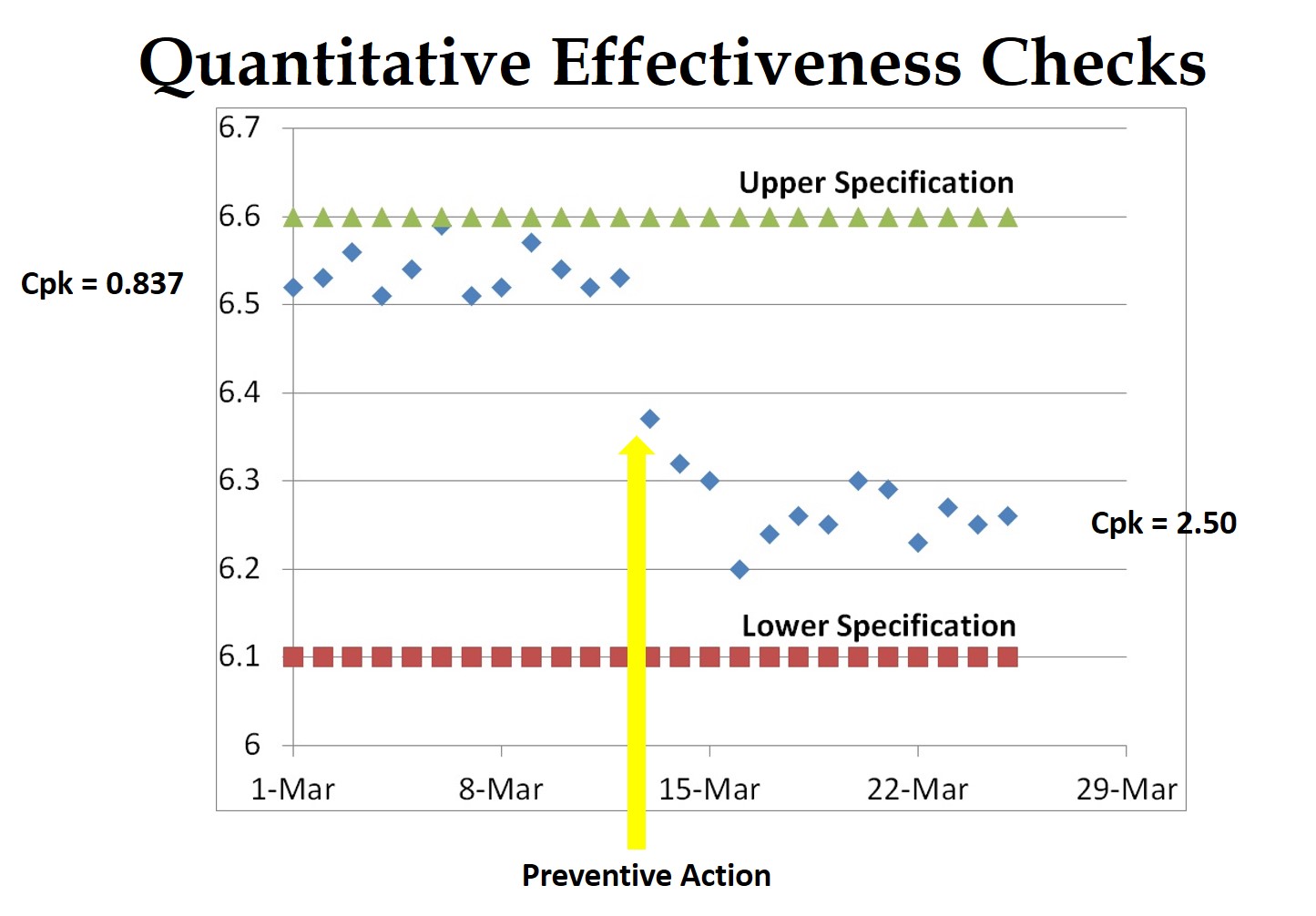
The best method is to establish quantitative criteria for effectiveness based upon data collected during the investigation of the root cause. The graph above is an example of objective evidence that preventive action was effective. The chart shows that the process capability (Cpk) was improved from 0.837 to 2.50 by changing a process set-point to adjust the mean of the dimension closer to the center of the specification range. This is typical of adjustments made during process validation and revalidation activities.

Square subscribe to our blog button 281x300 How to perform a quantitative CAPA effectiveness check

Incorrect Method 1: Verify the Procedure was Revised

When a nonconformity is identified during an ISO 13485 audit, the laziest way to “fix” the problem is to revise your procedure. Despite the fact that most FDA 483s identify inadequate procedures as the reason for observation, your procedures are seldom the problem. Your employees may not even be following the procedures. Repeatedly revising procedures may be part of the problem. If you must revise your procedures, please involve the people that use the procedures.

Incorrect Method 2: Verify Employees were Retrained

During your last surveillance audit, you may have revised the procedure, but your auditor noticed that there were no retraining records for employees that were performing the revised procedure. One interviewee was unable to identify where the new inspection step could be found in the revised procedure. It’s too bad the interviewee didn’t notice the bold and underlined text indicating recent revisions. Your auditor wonders how effective your retraining process is.

Incorrect Method 3: No Mistakes 3x in a Row

Last month a manufacturing engineer was assigned to perform an effectiveness check related to corrective actions implemented in the incoming inspection process. The procedure was revised to clarify the proper procedure for a statistical sampling of rolls of plastic film as a corrective action. The engineer sampled the three most recent lots of the same plastic film that was incorrectly sampled in the past. All three lots were correctly sampled in accordance with the revised procedure. The engineer reported that the corrective actions implemented were effective. However, you have two new nonconformities on your desk from manufacturing related to incorrect sampling procedures during an incoming inspection of other raw materials. Now you wonder if the incoming inspection procedure was the real root cause.

Corrective actions that are actually effective

Instead of adding something to your procedures each time someone makes a mistake, you might want to think about how you can simplify and streamline your procedures with fewer words. You can say things more clearly with pictures and flow charts instead of hundreds of words. Training effectiveness can be verified with exams that ensure employees “read and understand” your revised procedures. Finally, when you identify a nonconformity with one product, you need to ensure that you consider how similar mistakes might occur with similar products. Maybe you need a process for incoming inspection that doesn’t rely upon someone reading procedures.

You need to be objective to perform an effectiveness check

The biggest weakness of the auditing process is that it relies heavily upon the subjective opinion of an auditor. This is why auditors are supposed to audit against objective audit criteria in an international standard. The need for objectivity is also why there are guidance documents to clarify a consistent interpretation of those standards. Therefore, when you perform an effectiveness check, you also need objectivity. The best way to ensure objectivity is to establish documented criteria for effectiveness prior to finalizing your corrective action plan. Ideally, that will be in the form of a prospective process validation protocol with quantitative acceptance criteria.

How to ensure objectivity

The single best way to ensure objectivity when you are performing a CAPA effectiveness check is to define the post-implementation goal in terms of a quantitative quality objective. Ideally, you can graph the quality metric using historical data and current data. If you need statistical analysis to see a difference between pre- and post-implementation of the CAPA, then your CAPA was not effective. If your graph looks like a miracle happened and the metric changed almost overnight, and timing corresponds to the date your corrective action(s) was implemented, then your CAPA was effective.

How to set a quality objective for you CAPA effectiveness check

Some people have trouble with using a quantitative approach in performing effectiveness checks because some things are harder to measure than others. However, you can measure anything. For example, you can even measure employees forgetting to initial and date changes to quality records. This can be done by identifying critical control points where quality records are reviewed, and documentation errors are measured. You can measure by the employee, by form, by month, etc. The key to monitoring and measuring a process is to answer the following questions:

  1. Who will measure it?
  2. What will be measured?
  3. Where will it be measured?
  4. When will it be measured?
  5. How will it be measured?
  6. How will measurements be analyzed?
  7. Who will data analysis be communicated to?

When to Perform a CAPA Effectiveness Check

Many companies set arbitrary deadlines for performing an effectiveness check (e.g., – between 30 and 60 days of implementation of corrective actions). Some companies use a risk-based approach to their CAPA process, and the urgency of effectiveness checks may be a function of risk. I recommend a completely different approach. Instead of using an arbitrary or risk-based approach, I recommend monitoring your new quality metric to estimate how long it will take to reach your new quality objective.
%name How to perform a quantitative CAPA effectiveness check

If you are interested in learning more about CAPA, click here to register for Medical Device Academy’s Risk-Based CAPA webinar.

How to perform a quantitative CAPA effectiveness check Read More »

A3 Reports – The Missing Link to Effective CAPA Process Management

A3 Workbook A3 Reports – The Missing Link to Effective CAPA Process ManagementYour CAPA process is the most important process in your Quality System for two reasons. First, CAPA is the tool you use to fix quality problems. Second, your CAPA process is guaranteed to be an area of interest for your next FDA inspector.

Square subscribe to our blog button 281x300 A3 Reports – The Missing Link to Effective CAPA Process Management

If CAPA is so important, why do companies still have inefficient CAPA processes?

When auditors review a CAPA process, some start by reading the procedure. When the FDA writes a 483 observation about CAPA processes, the wording begins with “Procedures for corrective and preventive action have not been adequately established. Specifically…”. The approach of auditors and inspectors seems to suggest that your procedure is the key to an effective CAPA process, but your procedures are not the reason for the success or failure of processes.

Processes are effective when the management of the processes is effective. If a CAPA falls behind schedule, writing a justification for an extension is a process “solution.” A natural solution is managing the process better. Management needs to monitor the progress of CAPAs regularly, prioritize resources to ensure that CAPAs are completed on time, and make decisions on which actions should be taken to prevent the recurrence of quality problems. Therefore, you need to spend more time developing a method of managing CAPAs than you spend developing the CAPA process itself.

What is an A3 Report?

An A3 report is a tool that is ideally suited for managing CAPAs. “A3” refers to the size of the paper used (i.e., – approximately 11”x17”). An A3 report is a one-sided, single piece of paper used to build consensus among company management when making an important decision. The initial draft of the A3 report is distributed to each affected department to ensure that all possible inputs to a quality problem are received. By encouraging 360-degree feedback for a proposed solution to a quality problem, you will ensure that the CAPA you develop addresses the issue altogether.

In addition to encouraging 360-degree feedback, an A3 report includes an analysis of the problem, identification of the cause, proposed actions that require management decision, a section for documenting actions taken, and a follow-up section for management to review at specific milestones during the implementation plan. Including all of this information in one-page forces CAPA owners to summarize information for management, and the standardized format makes it easier for managers to locate the information they want.

Here’s how these sections would be used for managing CAPAs.

Analysis of the Problem

This section is identical to the section of a traditional CAPA record, where the investigation of the problem is documented. This is where tools such as 5 Why analysis, Pareto charts, and Fishbone Diagrams would be used to illustrate the analysis of the problem. This section may change a great deal during the 360-degree review of the A3 report.

Root Cause or Potential Cause

In this section, there should be a concise statement of the root cause for corrective action plans or the potential cause(s) for preventive action plans. During the initial review of the A3 report, management may ask the person or team assigned to the CAPA to investigate the problem in greater depth or investigate other possible sources of information if the analysis appears to be inadequate. Management should also ensure that the causes are within the company’s control to correct or prevent. Identifying a cause that is outside the company’s control is just placing blame.

Proposed Actions

This section is similar to a typical CAPA plan, but the section includes the reason(s) why the proposed actions are recommended. The reasons why actions are proposed are important during the process of management reviewing the initial A3 report and approving the recommended actions. The best practice is to phrase the reasons in terms of quantitative results that will be achieved because this will provide a framework for metrics during follow-up by management.

Actions Taken

This section of the A3 report is updated throughout the implementation of the project. By comparing this section with proposed actions, management can monitor the status of each task included in the CAPA plan.

Follow-up

This section of the A3 report identifies how management will monitor the implementation of actions and when. The initial A3 report identifies what management will be monitoring, how it will be monitored, and at what milestones. Ideally, the monitoring includes quantitative metrics demonstrating the CAPA’s effectiveness. During the implementation of the CAPA plan, actual metrics will be recorded in this section, and any adjustments that management makes are recorded here.

If you want to learn more about A3 reports, you can learn more from Daniel Matthews at http://bit.ly/A3Workbook.

You can also learn more about improving your CAPA process by attending one of the workshops on CAPA: September 9 in Orlando or October 3 in San Diego. Each workshop is one day, and early bird pricing is $249 per day if you register before August 1. 

A3 Reports – The Missing Link to Effective CAPA Process Management Read More »

CAPA Form – 15 tips to avoid CAPA failure

This blog reviews 15 tips for creating an effective CAPA form including source, quality issue description, and the root cause investigation.

Your cart is empty

CAPA Form 1024x362 CAPA Form   15 tips to avoid CAPA failure

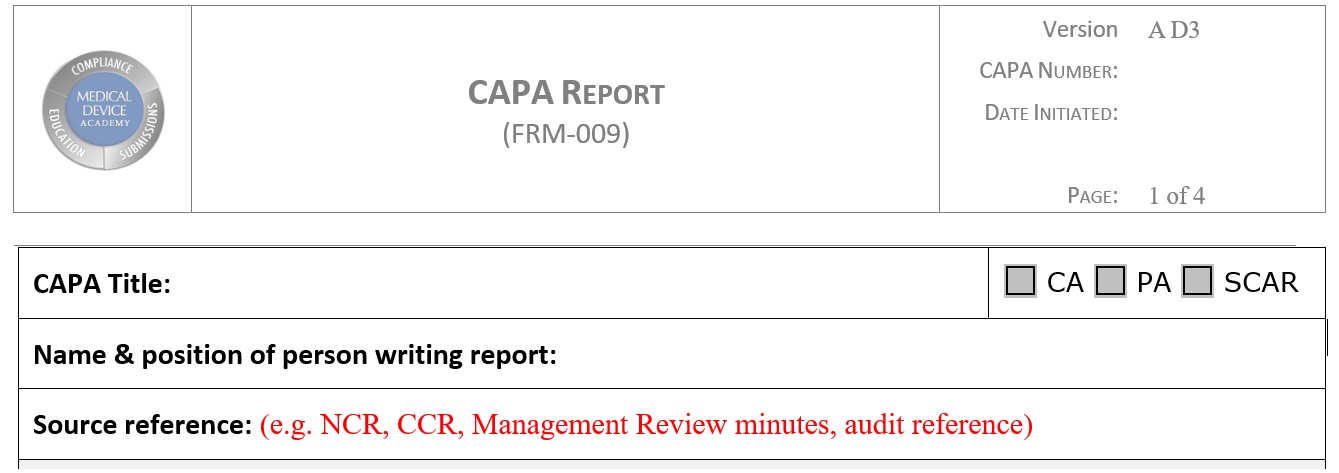
The reason for creating a “great CAPA form” is to improve the effectiveness of your CAPA process. Anyone in your company could be assigned to a CAPA, but not everyone is a CAPA expert. Therefore, designing an effective CAPA form can reduce errors and improve the effectiveness of the actions taken. You can also purchase our CAPA procedure and CAPA form, which is compliant with ISO 13485:2016.

Corrective and Preventive Action CAPA Procedure CAPA Form   15 tips to avoid CAPA failure
SYS-024 Corrective and Preventive Action (CAPA) Procedure, Form, and Log
Medical Device Academy's newly updated CAPA procedure is a 6-page procedure. Your purchase will also include our CAPA form (FRM-009), our CAPA log (LST-005), and a training webinar. The procedure is compliant with ISO 13485:2016, 21 CFR 820.100, SOR 98/282, and the EU MDR. You will also receive free updates in the future.
Price: $299.00

Provide adequate space in CAPA form

The most important feature of a CAPA form is to ensure that there is adequate space for writing a complete response for each section. Having sufficient space is more important than the benefits of a shorter record.

Square subscribe to our blog button 281x300 CAPA Form   15 tips to avoid CAPA failure

Date your CAPA form was initiated

The date your CAPA form begins to be completed can be used to verify that there was no “undue delay” in the initiation of a CAPA in response to internal audit findings. The date of initiation is also used to calculate the due date for completing the investigation and providing a corrective/preventive action plan.

Include a cross-reference number in your CAPA form

This is typically a sequentially assigned CAPA log number. Ensure the number is prominent on all pages—just in case pages are separated.

CAPA source

The source of a CAPA is useful information when performing data analysis—especially for internal audits where the audit schedule should reflect the results of previous audits. Examples of CAPA sources include:

  • Complaints/Reportable Events
  • Internal, Supplier, and Third-Party Audits
  • Service Work Orders
  • Nonconforming Materials
  • Management Reviews

Description of CAPA issue

I use the word “issue” instead of nonconformity because you need a CAPA form that will work for potential nonconformities (i.e., – preventive actions), as well as nonconformities. Typically, the wording is identical to a customer complaint or an auditor’s text, but the description of the issue identifies the symptoms observed. Specific references to records, locations, times, equipment, products, and personnel involved may be necessary for the root cause investigation.

The investigator assigned and target due date for the plan

In ISO 13485:2016, the only change to the requirements for corrective actions and preventive actions was the clarification that planning is required. Since this was always implied in the standard, your procedure should already comply with clauses 8.5.2 and 8.5.3 in the 2016 version of ISO 13485.

This section of your CAPA form should identify who is going to investigate the root cause of the issue and the date that a corrective/preventive action plan is needed. The FDA requires submitting a corrective action plan for all 483 observations within 15 business days, or it will result in an automatic Warning Letter. Most certification bodies require a plan within 30 days. Your target due date should be risk-based unless there is a specific regulatory requirement. The date will also need to be based upon the date the issue was identified—not necessarily the date the CAPA was initiated.

Documenting the investigation of the root cause is the #1 item in a CAPA form

This section always reminds me of the story about the Ohno Circle. Every company asks if they can close a nonconformity during an audit, and the answer should always be “No.” You can correct a problem, but you cannot perform a root cause investigation and implement an effective corrective action during the same audit. You need to investigate the cause and the investigation documented. Some companies include a specific tool in this section, such as a “Fishbone Diagram.” This is also a mistake because there are many root cause analysis tools, and you need to select the best one for your specific situation. You might even need to use more than one tool.

Is your CAPA form missing containment of nonconforming product?

If the issue requires preventive action, there is nothing to contain. If the issue is specific to a procedure’s deficiency, there is also nothing to contain. If the issue requires corrective action and nonconforming materials or products are involved, then you need to quarantine the affected items. If the affected product has already left the company’s direct control (see 21 CFR 806.2(l) for a definition), then you have a potential recall. Regulators often look for “bracketing” or “bounding” of the upper and lower lot limits for an issue. Therefore, this section is where you document the rationale for why certain lots of products/materials are quarantined, and other lots are not.

Correction(s) – Your CAPA form must separate this from corrective actions

Fixing the immediate problem does not prevent a recurrence, but regulators will verify that each occurrence of the issue identified during the investigation of the root cause has been corrected. You should verify that each of the nonconformities identified in the original finding and the investigation is addressed in this section of your CAPA form. For preventive actions, this section is not applicable.

Corrective Action Plan/Target Due Date for Implementation

These are the steps planned to prevent a recurrence. If the plan changes, then it should be updated. There is no need to delete the old version of the plan, but the new version should include a date when the plan was revised. For preventive actions, this section is not applicable. The target date of implementation should reflect the risk associated with the issue.

Preventive action plan / target due date for implementation

These are the steps planned to prevent the occurrence of nonconformity. If an issue occurred for one product, but not for others, the actions taken for other products can be preventive. In this case, both the corrective action plan and the preventive action plan sections should be completed. The target date of implementation should reflect the risk associated with the issue.

Corrective and preventive actions implemented – Update your CAPA form weekly

This section details what specific actions were performed—both corrective and preventive actions can be documented here. The dates of completing actions should be documented, and reasons for delays and overdue actions should be identified.

How to document your plan for verification of effectiveness – CRITICAL

I recommend filling this section before the plan for corrective and preventive action is developed. This often helps the person developing the plan to ensure that the actions planned are adequate. Whenever possible, this should be quantitative, and it helps to identify a specific date for performing the effectiveness check.

Verification of effectiveness

This section of your CAPA form is where you document verification of effectiveness. Specifically, what verification activities were performed to ensure that the corrective and preventive actions you implemented were effective. The date verification of effectiveness was performed should be documented, and if the actions were not effective, then a new CAPA should be referenced here.

Signature and closure date

Someone needs to review, sign, and date your CAPA form when it is completed. Often, regulators will review only closed records.

CAPA Form – 15 tips to avoid CAPA failure Read More »

CAPA Case Study

This blog presents a CAPA training case study related to hundreds of open CAPAs, and how to effectively remediate this issue using a CAPA filter to avoid “death by CAPA.”

Square subscribe to our blog button 281x300 CAPA Case Study

Years ago, when I took my first CAPA course, the student sitting next to me explained that he was taking the course as part of a consent decree with the US FDA. Evidently. his company had hundreds of open CAPAs that were not being closed promptly, and the CAPAs were ineffective when the records were finally closed.

Hundreds of open CAPAs?!

I was in total shock. You probably only have five to ten open CAPAs at your company. How could anyone have hundreds open?

He told me that every time a customer asked for technical support, a person was paged. If the page was not answered within three minutes, this was considered a customer complaint, and a new CAPA was opened automatically. The course instructor described the situation as “Death by CAPA.” His company did three things wrong    

1. Overreaction with Microscopic Focus

The company incorrectly identified failure to meet the three-minute target response time as a customer complaint. Also, several complaints related to the same issue should not result in a CAPA specific to each complaint.

2. Lack of Management Oversight

Nobody was tracking how long CAPAs remained open. There were no actions taken when target completion dates were missed. There were no reports to management on the status of CAPAs, and the only time CAPAs were discussed in a meeting was at the annual Management Review meeting.    

3. Failure to Check Effectiveness

Instead of verifying that corrective actions were effective, the company confirmed that corrective actions were implemented. Most of the corrective actions involved “retraining” or “revising the procedure.”

For any process to work correctly, you need to ensure that the process can handle the volume. If one person is responsible for managing hundreds of CAPAs each year, the CAPA process will be ineffective. You need more resources or fewer CAPAs. My recommendation is to use a CAPA filter.


Capa funnel photo CAPA Case Study

A CAPA filter does two things. First, it sorts CAPAs into problem categories. For example, all the poor response times to pages should be one problem with one CAPA. Second, a CAPA filter sorts CAPAs according to risk. A response to a page within five minutes instead of three minutes results in a customer waiting longer. A customer receiving no response could have a more severe impact, especially if the customer has diabetes that cannot seem to get their glucose monitoring device to work correctly.

Trend Analysis

Therefore, response rates to pages should be a metric subject to monitoring and measuring—not necessarily a CAPA. You have a positive trend if the number of late responses is declining, and the average delay is steadily shrinking. In this case, there may be no need for a CAPA. You have a negative trend if the number of late responses is increasing, or the average delay is getting longer. In this case, one or two CAPAs may be needed—not one CAPA for each occurrence.

Depending upon the issue, there may be a safety issue associated with extreme limits. In this case, it is recommended to establish alert limits and action limits. Alert limits may increase the frequency of monitoring and measuring, and corrections may also be implemented. However, if the action limit is reached, then a CAPA may be required.

Quality Plan

When I audit a company, it is not uncommon to observe a problem and to quickly identify a root cause. This frequently happens when the issue is familiar to many companies, and the root cause is: 1) inadequate procedures, 2) insufficient training, or 3) inadequate management oversight. If the problem is limited to one area, a CAPA may be entirely appropriate. However, if I observe the same type of problems in several areas, then the root cause is systemic. This can happen in a company where the following problems exist at the same time:

  1. The training procedure does not require demonstrating training effectiveness
  2. Employees are only required to “read and understand” procedures
  3. The top management has put a “freeze” on spending related to training

In a small company, this trifecta of doom is not uncommon. Therefore, in these cases, a CAPA does not address the root cause. Many companies will mistakenly identify the root cause as an “inadequate procedure.” The correction will be to fix the problem caused by the inadequate procedure. The corrective action will be to revise the procedure.

This is only a partial solution because it does not address the root cause. A stronger approach is to identify the root cause as an “ineffective training process.” The correction will be the same. The corrective action, however, will be expanded to include the initiation of a Quality Plan for changing the company training process.

The combined approach of a CAPA plan and a Quality Plan is a better solution because the process change will affect the entire Quality Management System and will require many months to implement fully. This is especially true if resources are constrained.

Here are a couple of upcoming webinars I am doing on CAPA and Complaint Handling:

CAPA Case Study Read More »

Scroll to Top